One of the Top 10 "Asthma Drugs" in This Query Wasn't a Drug At All
The question behind this one is a real healthcare-operations problem, not an academic one:
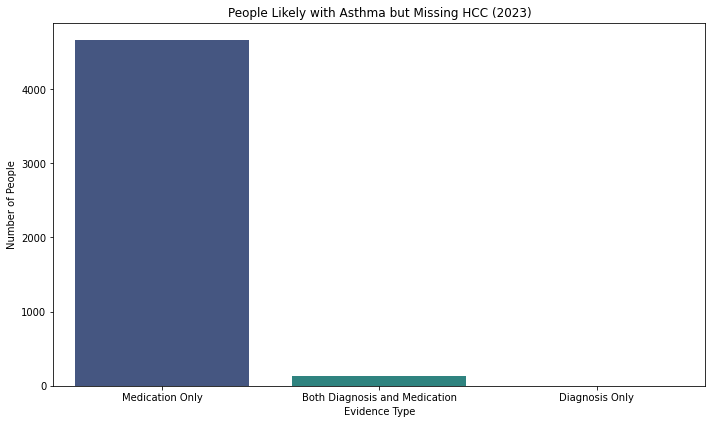
"Look at people that have an asthma HCC in 2023. Then look at their 2023 data (conditions, drugs) and identify people that likely have that condition but don't have the corresponding HCC. Group by reasons and give counts. Give a visual too."
An HCC (Hierarchical Condition Category) is a diagnosis code group that risk-adjustment payment models — Medicare Advantage, ACA marketplace transfers — use to price how sick a patient population is. If a patient clearly has a condition but it's never formally coded, the payment model doesn't know that patient is sick. That's not just a records problem; in a risk-adjusted system, it's a revenue and care-quality problem. We've written before about how tightly MEPS risk scores track spending — this is the flip side: what happens when the coding that feeds those risk scores has gaps.
The Method
VerbaGPT's approach was two queries, run directly against MEPS's claims tables in Snowflake (via Gemma 4 31b, generating code after a separate gpt-oss-120b schema-resolution pass — both open-weight models, both hosted on Cerebras, the whole round trip under 21 seconds including two full SQL joins across four tables of five years of pooled claims data):
- Among people with an asthma HCC in 2023, find the most common diagnosis codes and the 10 most frequently prescribed drug names.
- Among people without the HCC, flag anyone with an asthma-pattern diagnosis code (J45) or one of those 10 drugs — then group by which kind of evidence they had.
| Evidence Type | Patient Count |
|---|---|
| Medication Only | 4,664 |
| Both Diagnosis and Medication | 136 |
| Diagnosis Only | 3 |
| Total | 4,803 |
4,803 people show clinical evidence of asthma with no corresponding HCC in 2023 — and 97% of that group was flagged on medication alone. On its face, that reads like a real documentation gap: patients being treated pharmacologically for asthma whose diagnosis never made it into a coded claim.
Where It Falls Apart
The two queries above ran exactly as written, correctly, against the real data. The problem isn't the SQL — it's what went into the drug list. Here are the actual 10 drug names the first query returned, unfiltered, ranked by frequency among the asthma-HCC population:
ALBUTEROL, MONTELUKAST, ATORVASTATIN, METFORMIN, -15, FLUTICASONE-SALMETEROL, LEVOTHYROXINE, AMLODIPINE, BUDESONIDE-FORMOTEROL, GABAPENTIN
Four of these (bolded) are genuine asthma medications. The rest are a statin, a diabetes drug, a thyroid drug, a blood-pressure drug, and a nerve-pain drug — the kind of medications that show up constantly in any population sick enough to have any HCC, asthma or otherwise. "Most frequent drug among people with condition X" and "drug specific to condition X" are different questions, and the query only asked the first one.
And then there's -15. It's in the list because it was one of the ten most frequent values in that column — but per MEPS's own documentation, -15 isn't a drug. It's the survey's missing-data code for "cannot compute." It ranked in the top 10 the same way a real drug would, and the second query's WHERE RXDRGNAM IN (...) clause treated it exactly like one — meaning some number of the 4,664 "Medication Only" patients were flagged because a field in their record couldn't be computed, not because they were on an asthma drug.
The 4,803 headline number isn't wrong, exactly — it's what that specific query, as written, produces. But it's contaminated by two different failure modes stacked on top of each other: generic comorbidity drugs diluting a disease-specific signal, and a literal missing-value sentinel slipping in as if it were data. The most trustworthy number in the whole table is actually the smallest one — the 136 patients with both the J45 diagnosis code and a flagged drug, which doesn't depend on the drug list being clean.
Why This Generalizes
Picking "top N most frequent values" as a stand-in for "values relevant to X" is one of the most common traps in real-world claims and survey analytics — and MEPS's negative sentinel codes (-1, -7, -8, -15, each meaning a different flavor of missing) are exactly the kind of thing that can rank highly by pure frequency without anyone intending it. This isn't specific to asthma, or to MEPS: any dataset with missing-value codes runs the same risk the moment a frequency-based feature list goes into a filter clause unreviewed. The fix isn't a smarter model — it's a domain-literate human glancing at the drug list before it goes into the query, the same way you'd want a claims analyst to sanity-check it on your own data.
Data source: Medical Expenditure Panel Survey (MEPS), person-level conditions, HCC flags, and prescription fills, 2023. One of VerbaGPT's built-in sample datasources.
Ask your own question about this dataset → The MEPS datasource is live and open — no signup required for a few questions.
Related
Every Point on This Rainfall Chart Represents a Decade. Except One.
Back Pain Diagnoses Dropped in 2020. Anxiety Diagnoses Never Paused.
Mild Diabetes Is Overpriced. Severe Diabetes Is Underpriced. Same Risk Score.
Healthcare Spending Doesn't Scale Linearly: A Decile Analysis
A Model Guessed Its Own Result Wrong. The User Never Saw It.