The Newest GLP-1's Off-Label Share Is Already Double Ozempic's
The prompt gave Taurus — VerbaGPT's local, agentic mode — a wide berth on purpose:
"Can you review GLP-1 use over 2020-2023, break it down by interesting categories. Give me insights and visuals where helpful."
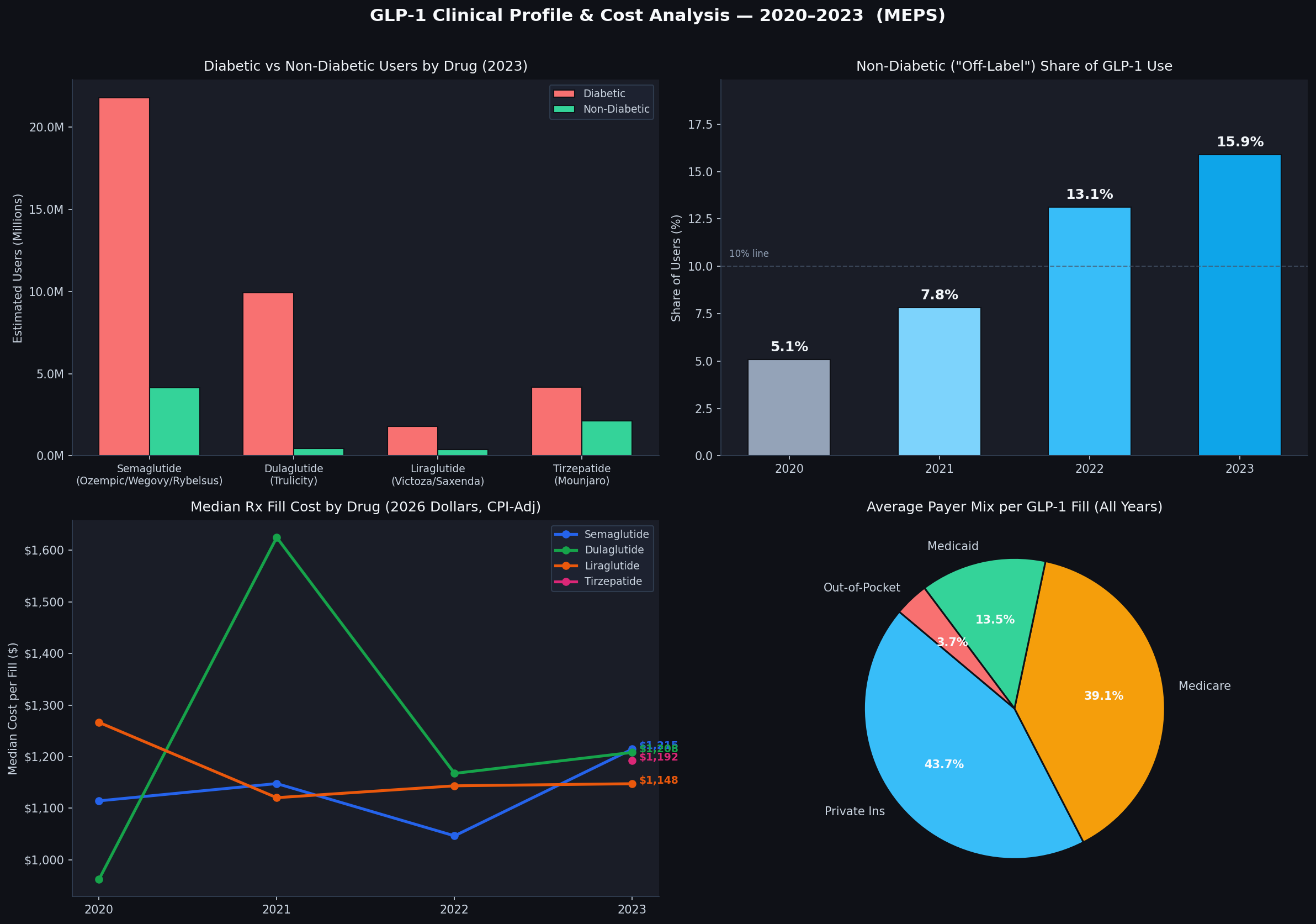
Taurus searched MEPS's prescription table for GLP-1 receptor agonists by matching active ingredient and brand names, landing on 8,878 person-year prescription fills between 2020 and 2023 across four drugs: semaglutide (Ozempic, Wegovy, Rybelsus), dulaglutide (Trulicity), liraglutide (Victoza, Saxenda), and tirzepatide (Mounjaro). Joined to demographics and weighted to the national population, the class grew from an estimated 16.5 million US users in 2020 to 44.9 million in 2023 — unsurprising, given how much press GLP-1s have gotten. The more specific number is in how that growth broke down by drug, once you split each one into diabetic and non-diabetic users:
| Drug (brand) | Diabetic (M) | Non-Diabetic (M) | Non-Diabetic Share |
|---|---|---|---|
| Dulaglutide (Trulicity) | 9.91 | 0.44 | 4.3% |
| Semaglutide (Ozempic/Wegovy/Rybelsus) | 21.80 | 4.15 | 16.0% |
| Liraglutide (Victoza/Saxenda) | 1.80 | 0.39 | 17.8% |
| Tirzepatide (Mounjaro) | 4.19 | 2.12 | 33.6% |
MEPS doesn't record why a prescription was filled — a "non-diabetic" user here just means the person had no diabetes diagnosis flagged that year, which is the closest proxy this data has for off-label or weight-loss use. By that proxy, Tirzepatide's 2023 user base was already a third off-label — roughly double Semaglutide's rate and nearly eight times Trulicity's, despite being the newest drug in the class by a wide margin. Tirzepatide only received FDA approval in May 2022; by the 2023 snapshot in this data it had barely eighteen months on the market, and its dedicated obesity brand, Zepbound, wasn't approved until November 2023 — right at the tail end of the window. Trulicity, by contrast, has been a diabetes-only brand for over a decade with no obesity indication at all, which tracks with its near-zero off-label share. Semaglutide sits in between, but notably: it's had a dedicated obesity-approved brand (Wegovy, approved June 2021) actively on the market for over two years by this point, and its non-diabetic share is still half of Tirzepatide's.
The pattern that breaks is the assumption that off-label use builds up slowly as a drug earns a reputation. Trulicity and Semaglutide both look like that — years on the market, off-label share climbing gradually. Tirzepatide skipped that ramp. It arrived already carrying the reputation that took the other drugs years to build, most plausibly riding two years of "Ozempic for weight loss" media coverage that had already primed patients and prescribers on what a GLP-1 could do for them, months before Tirzepatide had its own obesity-branded version to point to.
Worth being precise about what this number can and can't say: a diagnosis flag captures whether diabetes was coded that year, not the actual reason someone was prescribed the drug — a physician can code a diabetes diagnosis specifically to secure insurance coverage even when weight loss is the real intent, which would undercount true off-label use in every row of that table, not just Tirzepatide's. But a four-to-one gap between the oldest diabetes-only brand and the newest entrant, inside the same survey, the same year, the same drug class, is bigger than that kind of coding noise alone would explain.
Getting to that table took some real back-and-forth. Taurus runs as an agentic session — this one on claude-sonnet-4-6 — that inspects the schema itself rather than working from a pre-built prompt, and here it had to look across four related MEPS tables (conditions, HCC flags, the main person-year table, and prescriptions) before it found the right join keys. One SQL attempt failed outright on a mistyped column reference (RXXPX instead of the real RXXP); Taurus caught the error, re-inspected the schema, and corrected it before moving on. Two case-sensitivity mismatches (a query built assuming YEAR was uppercase in a table where it was lowercase) got the same treatment. None of that shows up in the four charts it eventually produced — only in the full trace behind them — but it's the difference between Taurus's iterative, self-correcting tool use and a single-shot query: the wrong turns get caught and fixed inside the same session, six minutes start to finish, rather than surfacing as a bad answer.
None of that exploration was hard-coded for MEPS or for GLP-1s. The same schema-first, self-correcting search runs whenever Taurus is pointed at an unfamiliar table in your own warehouse — a new drug class, a new product line, any dataset nobody's written a query against yet.
Data source: Medical Expenditure Panel Survey (MEPS), prescription fills (all_years_rx) joined to person-year demographics (all_years_narrow) by generic drug name, 2020–2023 (AHRQ). One of VerbaGPT's built-in sample datasources.
Related
GLP-1 Spending Nearly Quadrupled. Cost Per Patient Peaked in 2021.
The Income Group With the Lowest GLP-1 Use Isn't the Poorest One
Mild Diabetes Is Overpriced. Severe Diabetes Is Underpriced. Same Risk Score.
Self-Rated Health Isn't Sticky. 47% Went From Poor to Good in a Year.