Agent Skills in LLMs: A Weather Analysis Case Study
In the Matrix, there's a great scene where Neo points to a helicopter and asks Trinity: "Can you fly that thing?" Trinity responds "Not yet" — and asks the operator to remotely upload the skill. Moments later: "I can fly that thing now."
The agent skills protocol for LLMs reminds me of that scene.
What Are Agent Skills?
The idea is simple: domain expertise can be loaded on-demand by the LLM at runtime, directing itself without the user having to provide the context. You don't need to know climatology to get a rigorous climate analysis. You just need a skill that does.
A Real Example: Denver Weather Analysis
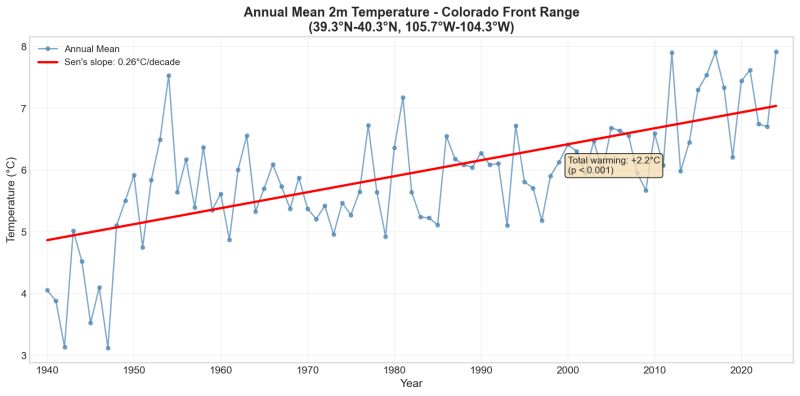
Denver has been having unusually warm weather. I kept commenting "this is highly unusual" — but I wanted to know if that was a feeling or backed up by data.
I ran a first analysis and shared it. I got feedback from a few knowledgeable people about what was missing:
- Sen's slope — a robust statistical method for trend analysis in climate data
- The right way to cut data by seasons rather than calendar months
- Focusing on deviations from historical means rather than raw values
- Joy plots (ridge plots) for visualizing distributional shifts over time
I added these suggestions as-is into a VerbaGPT agent skill and re-ran the analysis. The results surprised me. Even without any weather expertise, I could tell the quality of output was dramatically better.
Why This Matters
The agent skills protocol is highly useful in practice. Skills capture what domain experts know — statistical methods, domain-specific data transformations, visualization conventions — and make that expertise reusable by anyone. The knowledge is encoded once and applied systematically every time.
The power is especially apparent in multi-stage analysis. A skill can activate at exactly the right moment in a pipeline — injecting Sen's slope when trend analysis is detected, switching to seasonal decomposition when the query involves time periods, surfacing the right visualization type for the data shape.
The Broader Principle
This is how knowledge work scales. Not by replacing domain experts, but by making their expertise portable and reusable. An analyst who doesn't know climatology can still produce climatologist-quality work — and the climatologist's time is spent validating and refining, not re-explaining the basics from scratch every time.
It's the same principle behind VerbaGPT's Data Notes, Footnotes, and Prompt Libraries — but applied to the analysis layer itself.
Data source: ERA5 monthly averaged data on single levels (2m temperature), 1940 to present.
Originally posted on LinkedIn · December 2025