VerbaGPT vs Databricks Genie: Analyze the Databases You Already Have
Genie is Databricks' natural-language interface for data. A data team sets up a Genie space over tables in the workspace's Unity Catalog, adds instructions and sample queries, and business users ask questions in plain English and get answers, charts and, in agent mode, multi-step research reports. If your data already lives in Databricks, it is a natural way to let more people use it.
VerbaGPT solves the same core problem, natural language to analysis, but starts from a different place: the databases and files you already have, wherever they are, with no platform to adopt first. If your data is in PostgreSQL, MySQL, SQL Server or Snowflake, or in a folder of spreadsheets, this comparison is for you.
Short version: Genie is excellent inside the Databricks lakehouse. VerbaGPT is for teams whose data lives in PostgreSQL, MySQL, SQL Server, Snowflake or files, including companies that use Databricks for part of their data but do not want every business user working through a Genie space. It adds Python analysis, a data dictionary you own, and a local mode for sensitive data.
At a glance
| Capability | VerbaGPT | Databricks Genie |
|---|---|---|
| Natural language → analysis & charts | Yes | Yes |
| Works on your existing databases (PostgreSQL, MySQL, MSSQL, Snowflake) with no migration | Yes, connect directly | Data is queried through Unity Catalog, so outside sources must be brought into Databricks first |
| Analysis beyond SQL: Python statistics, models, custom plots | Yes, Python is the core | Built around SQL queries over tables |
| File analysis (CSV, Excel, JSON, PDF, Google Drive) | Yes, upload and ask | Files go into Unity Catalog volumes; file analysis in agents is in Beta |
| Data-dictionary context layer | Yes (Data Notes) | Yes (instructions, sample queries, Unity Catalog comments) |
| Simplicity for non-technical experts | A single chat, with no platform to learn | Clean chat, inside a broad data platform |
| Time to first answer | Connect a database or upload a file | Workspace, Unity Catalog tables, a SQL warehouse, then a configured Genie space |
| Team governance: orgs, roles, audit logging | Yes | Yes, through Unity Catalog |
| Model choice | Model-agnostic | Databricks-managed |
| Local mode: data stays in your environment | Yes (Taurus) | Runs on the Databricks platform |
| Pricing model | Free tier, no credit card | Platform compute and usage billed in Databricks units; Free Edition is quota-limited |
Competitor capabilities reflect publicly available documentation and can change. Always confirm current features on the vendor's site.
1. Your data where it already is
Genie answers questions about tables registered in a Databricks workspace's Unity Catalog. That is a strength if you have invested in the lakehouse, and a hurdle if you have not: before the first question, your data has to be ingested or federated, a SQL warehouse has to be running, and someone has to set up a Genie space around the right tables.
VerbaGPT treats PostgreSQL, MySQL, Microsoft SQL Server and Snowflake as first-class datasources. Connect once, then ask questions against live data. You can also upload files, and combine files with live database connections in the same conversation.
2. Python, not just SQL
Genie turns questions into SQL queries over your tables, and its agent mode runs several of them to build a report. That covers a great deal of business analysis. But when the question is a regression, a forecast, a clustering, or a chart that SQL cannot express, you want a real programming language. VerbaGPT writes and runs Python for your analysis, in the cloud in a sandbox that never holds the platform's own credentials, or locally on your own machine.
Genie can still attempt a regression in SQL, and in our test below it produced a forecast. The difference we saw was in how much it told us about the model. We ran the same questions through both tools on the same data; the results are in the head-to-head section further down.
3. A context layer you control
Both products know that the model's biggest handicap is missing context, not intelligence: what status = 2 means, which column joins to which table. Genie reads Unity Catalog descriptions plus the instructions and sample queries a space's author adds. VerbaGPT's Data Notes are a structured data dictionary (database, table, column, value and sample-question levels) whose structure (tables, columns, types and detected relationships) is created automatically when you add a datasource. Your admins then add the business meaning once, such as what counts as revenue or when the fiscal year starts, and it travels with every query for the whole team. The meaning is written by a person; it is not guessed.
4. A real answer for sensitive data
For privacy-conscious teams, VerbaGPT's local Taurus mode runs on your own machine. Your databases and files stay in your environment and are never uploaded to VerbaGPT's servers. Only the query and the relevant context needed for reasoning are sent to the AI model, and an incognito mode stores nothing. Teams that want to go further can run the model that writes Virgo's analysis code on their own machine with Private Inference, and connect databases on their own network without exposing them to the internet.
5. Fewer dials for the people asking the questions
The person who knows the business best is rarely the person who knows the tooling. A sales lead, a clinician, or a finance manager has the questions, and every extra switch between them and the answer is a reason not to ask. Interfaces that expose every option make a good demo and a poor daily tool for non-technical subject-matter experts.
To be fair, Genie's chat screen is clean: a question box, an answer, a table, a chart. But it lives inside a full data platform. In our test, the left-hand navigation alone listed Catalog, Jobs & Pipelines, Compute, Marketplace, SQL Editor, Queries, Dashboards, Alerts, Query History and SQL Warehouses, and a Genie space adds its own Monitor, Benchmark and Configure tabs for the people who build it. Those tools matter for a data team. For a business user, they are a lot of unfamiliar surface around one text box.
VerbaGPT aims to keep the person asking focused on the question: pick a database or drop in a file, ask in plain English, read the answer. The chat box does have a few optional controls, such as speed versus depth and web search, but the harder decisions (which tables are relevant, how a column should be interpreted) are handled by Data Notes and your admins rather than by the person asking. We keep working to make it simpler, because for a non-technical expert, less to learn means more questions asked.
6. Getting started, and what it costs
Databricks offers a Free Edition for trying the platform. It is limited to serverless compute, a single small SQL warehouse, and a fair-use quota that can pause compute until it resets. Beyond that, usage is billed in Databricks units. VerbaGPT's free tier needs no credit card, and you can be asking questions of your own data within minutes of connecting it.
Head-to-head: the same data, the same questions
On October 25, 2026 we put six questions to both tools on the same data (VerbaGPT's results are from the version running at the end of that day): Databricks' sample "Bakehouse" bakery dataset (3,333 sales transactions, 48 franchises, 300 customers, 27 suppliers and 204 customer reviews). Genie used its Bakehouse starter space. For VerbaGPT we loaded the same tables into a SQL Server on our own laptop and connected it as a local database, which Genie, working inside Databricks, cannot do. The questions were written down before we started and typed word for word into both tools. Both were given the same business rules (revenue is the totalPrice column; the fiscal year starts in February). VerbaGPT ran in its fast Quick mode and, where the table says so, its deeper Thorough mode, which costs more (roughly 7 to 10 cents per answer here, against 1 to 2 cents for Quick). Genie ran in its default chat mode, with its agent mode also tried on question 3. We told neither tool about the quirks in the data, such as the sales covering only May 1 to 17, 2024, or some franchises having no matching supplier.
| Question | VerbaGPT | Databricks Genie |
|---|---|---|
| 1. What was our revenue in May 2024? (true answer: 66,471) | Correct in all 6 runs: $66,471, in 3 to 29 seconds. In Thorough mode it also volunteered the key caveat, because the data stops on May 17: "This is not a full-month figure." None of Genie's five answers said so. | Correct total in 2 of 5 runs. The others: a wrong total twice (48,234 and 44,669) and no total once. One correct-total run also named the wrong lowest franchise. In the runs we inspected closely, the SQL and result table were right; the sentence above them was the problem. |
| 2. Which franchise had the highest revenue per transaction, and who supplies it? | Correct in both runs on the current version: Baked Bliss, and that no supplier is on file for it. It also flagged that five of the top ten franchises have no supplier record. | Correct: Baked Bliss at 105.43, and said the supplier name is not in the data. |
| 3. Regression of daily revenue on day of week and a time trend, with R-squared and a 30-day forecast chart | Thorough mode matched our independent calculation exactly (R-squared 0.427 on the 16 complete days, trend -18.3 per day, p = 0.246). It excluded the partial last day and explained why, gave prediction intervals, and warned that the declining forecast is probably an artifact of a weak estimate. Quick mode was less consistent: one run kept the partial day in the fit, another coded day of week as a single number. | Close, with more detail in agent mode. Chat mode: R-squared 0.5107 and a forecast chart. Agent mode (about two minutes): R-squared 0.51, a regression equation with a trend of about -$52 per day, and a forecast chart. Both used all 17 days including the partial last one, and neither gave significance tests or a small-sample warning. |
| 4. Do franchises with more positive customer reviews have higher revenue? | Thorough mode: the most complete answer. No relationship, with the method stated (VADER sentiment, 168 of 204 reviews positive), three review measures, Pearson and Spearman correlations with p-values, a group comparison, and caveats about the small sample and the mismatch between review dates and sales dates. Quick mode reached the same conclusion with a scatter plot. | Answered: no relationship, from a correlation of -0.18 on a count of positive reviews. No significance test and no caveats. |
| 5. What was revenue by fiscal quarter? | Correct: Q2, 66,471, and noted that only one quarter exists in the data. | Correct: Q2, 66,471, and noted that only one quarter exists in the data. |
| 6. Group the franchises into 3 clusters by total revenue, average ticket size and number of transactions, describe each cluster, and show a chart | Real clustering (Thorough mode): K-means with standardized features, three named clusters of 2, 26 and 20 franchises with their averages, an explanation of what separates them (ticket size isolates the two high-ticket franchises; transaction volume splits the rest), a warning that the top cluster rests on two data points, and two charts. | Three labeled tiers (High, Medium and Low Performers) with five example franchises. It did not state its method or give cluster sizes or averages, and ended by asking whether we wanted a different number of clusters or method. |
Question 1 was run five times in Genie and six in VerbaGPT, and question 2 twice in VerbaGPT; the rest were single runs unless noted. AI tools vary from run to run, so treat this as one honest sample, not a benchmark.
What we take from it
- Both tools were right more often than not. Neither is a toy, and where both had the same business rules (question 5), both applied them.
- Genie's slip was in the sentence, not the query. On the simplest question its SQL and result table were right in the runs we inspected closely, but the written summary had an error or left out the total in four of five runs, and the mistakes differed from run to run. A non-technical reader reads the sentence first.
- Both tools handled the messy supplier data well. Genie said the supplier name was not in the data. VerbaGPT ranked the franchises correctly, said no supplier is on file for the winner, and flagged that five of the top ten franchises have none.
- Questions that need statistics or machine learning (3, 4 and 6) are where VerbaGPT pulled ahead. It ran real models, said how it measured things, reported significance, and warned about small samples and mismatched dates. Genie, working in SQL, gave a usable answer on each but with far less detail.
- The regression question favored Python, and the mode mattered. VerbaGPT's Thorough mode produced numbers that matched an independent calculation, handled the partial last day correctly, and came with the context needed to judge the forecast. Its faster Quick mode was less consistent from run to run. Thorough costs more (about seven cents for this answer, against one to two cents for Quick), so choose the mode to fit the question. Genie's agent mode came closer to a full answer than its chat mode, with an equation and trend estimate, but it fit all 17 days, said the model "explains approximately 51% of the variance" without noting how little data that rests on, and did not test significance.
- Speed. VerbaGPT answered in about 3 to 29 seconds in Quick mode and about 30 to 50 seconds in Thorough mode; Genie took roughly half a minute to two minutes per answer (we did not time Genie precisely).
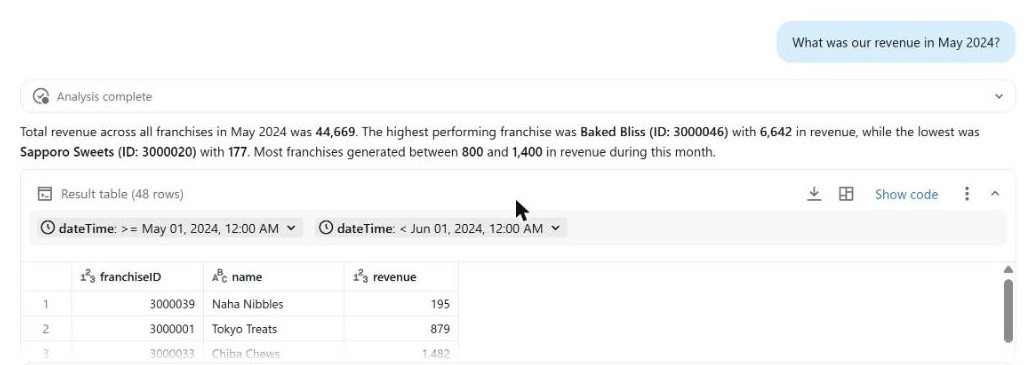
Genie's second answer to question 1: the sentence says 44,669, but the true total is 66,471.
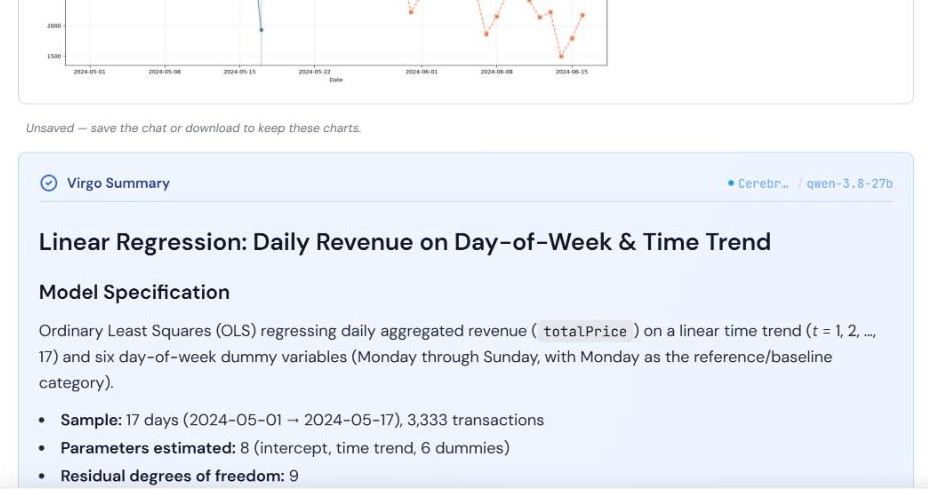
VerbaGPT's answer to question 3: the forecast chart and the start of the model summary.
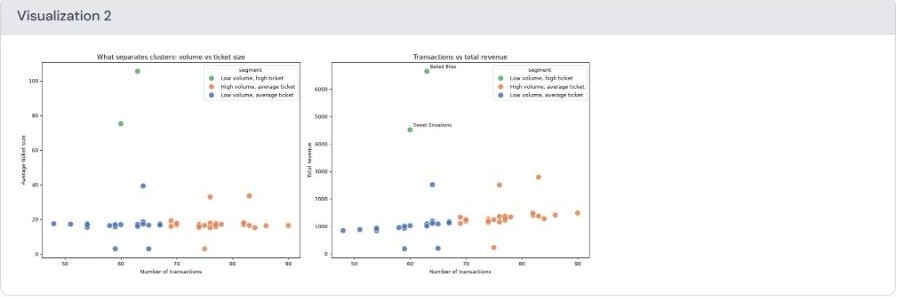
VerbaGPT's answer to question 6: three clusters, with the two high-ticket franchises standing apart.
One more caveat: this is a small, tidy sample dataset, with 17 days of sales, so your own data will be messier. That is why we suggest running your own questions on your own data.
When Databricks Genie might be the better fit
We'd rather you choose well than choose us blindly. Genie is the right pick if your data and your data team already live in Databricks, your questions are well served by SQL over governed tables, and you want business users inside the same platform that holds the data. Unity Catalog's governance is a real advantage there, and it is hard to beat having analysis next to the data.
VerbaGPT is the better fit when your data lives outside Databricks, when you need Python analysis, when you want to be productive without adopting a platform, or when some of your data is too sensitive to leave your environment.
Try it with your own data
The fastest way to compare is to point VerbaGPT at a dataset you actually care about, ideally one you have already tried elsewhere. The free tier needs no credit card.
See the difference on your data
Connect a database or upload a file and ask your first question in plain English.
Get Started FreeNo credit card required